
How to Track Partial Progress When You Miss or Beat Your Daily Goal
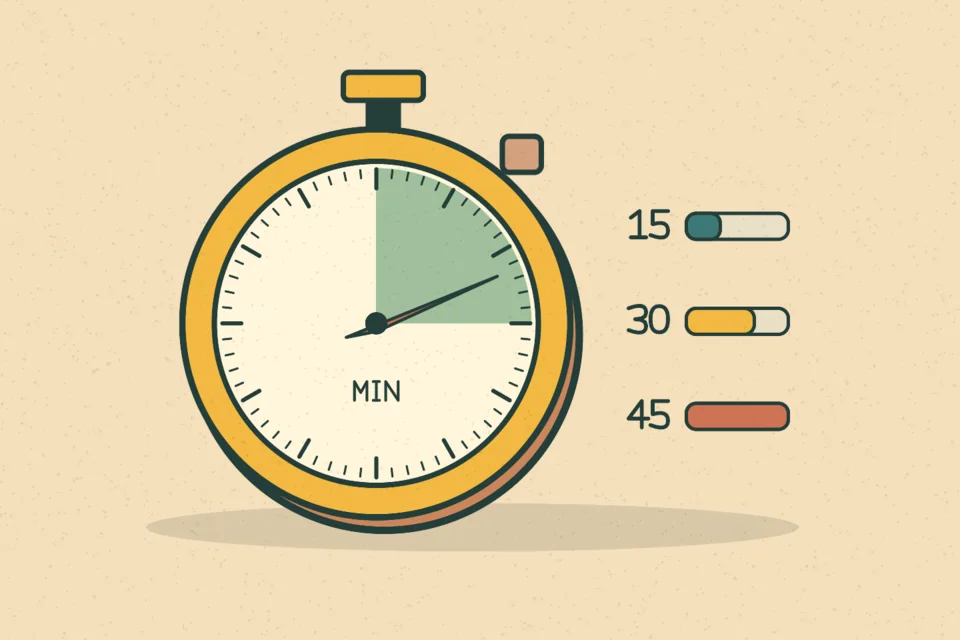
If your goal is 30 minutes of exercise and you walk for 15, record 15 minutes. You exercised that day and reached half your target. If tomorrow’s walk lasts 45 minutes, record all 45. Keeping the amount you actually did lets you answer two questions later: “How much exercise did I get?” and “On how many days did I make time for half an hour?”
How do you calculate partial progress toward a habit goal?
Divide the amount you did by the amount you planned, then multiply by 100. With a goal of 30 minutes, 15 divided by 30 is 0.5, or 50%. You can do the same with pages, laps, or practice problems. Use the same unit on both sides. If your goal is half an hour and your timer reads 18 minutes, divide 18 by 30 to get 60%.
Imagine three lunch breaks with that same 30-minute walking goal. On Monday a call brings you back early. On Tuesday you take your usual route. On Wednesday a friend joins you and you take the long way home.
| Day | Time walked | Share of daily goal | Reached 30 minutes? |
|---|---|---|---|
| Monday | 15 minutes | 50% | No |
| Tuesday | 30 minutes | 100% | Yes |
| Wednesday | 45 minutes | 150% | Yes |
If you’d rather skip the arithmetic while you’re out, write only the minutes. A paper tracker can hold all three answers in one row. Put the number in the day’s square, then circle it if you reached 30. The numbers tell you how long you walked. Counting the circles tells you how many days reached the goal.
What does an average hide when you go over your goal?
Across those three lunches, you walked 90 minutes, averaging 30 minutes a day. You reached your daily goal on two of three days. Monday’s 15 minutes still contributed to your total, and Wednesday’s extra 15 minutes still belong to Wednesday. A chart that stops its progress bar at 100% can work for showing whether you reached the target, provided you can also see the full 45 minutes somewhere.
Which figure should guide next week’s plan? If you’re trying to fit a half-hour break into every workday, look into Monday. If what you care about is finding 90 minutes to walk over three lunches, this plan gave you exactly that. The same record might prompt you to block off Monday’s calendar or to keep Wednesday’s longer route. Choose the figure that answers the decision you’re making.
How do you add two short sessions without double counting?
Suppose you read for 10 minutes over breakfast and another 15 on the bus. With a daily reading goal of 25 minutes, breakfast brings you to 40%. The bus ride takes you to 25 minutes and 100%. If you enter each new session separately, the two entries are 10 and 15. If you update a single running total instead, it changes from 10 to 25.
Check how your tracker handles the second entry. A field labeled “add minutes” expects just the latest session. A field that asks for “today’s total” expects the full 25. If your record says 35 after the bus ride, the extra 10 probably came from adding a daily total to an entry that was already there.
In a ShineDay walkthrough, the Read a book habit started at 10 of 25 minutes. Quick Check-in was set to add five minutes per tap. Three taps brought the total to 25 of 25. That’s how you could record the 15-minute bus ride in this example. The before-and-after screenshots let you check exactly what changed. See the two reading entries or try logging progress in the demo.
Which habits need a number, and when is a checkmark enough?
Start from the decision you want to make. If you want to know whether you opened your sketchbook after dinner, a checkmark answers it. Counting pages might give you the awkward job of deciding whether a page of thumbnail sketches equals a full-page drawing. If the decision is whether to keep a 20-minute slot open for drawing, a timer gives you a more useful entry.
For a reading goal, pages work well when you stay with the same book and want to know how far you got. Minutes are easier to compare when a week includes a dense textbook, a novel, and a bus ride with an audiobook. If you use both units, give them separate spaces. Twelve pages at breakfast and 15 minutes of listening in the evening are two perfectly good entries. Adding them together gives you a number with no unit you can use. Set up a daily reading-time goal
How should you log a low-energy day or an untimed session?
Suppose you pick up your guitar, tune it, and play for five minutes before dinner. If you want to protect a half-hour for practice, enter five minutes. If you’re trying to build the habit of picking up the guitar each evening, that session earns a checkmark. You can keep both fields when the distinction helps you decide what to work on.
An untimed session needs a different entry. Say you remember playing the new chord progression but have no idea whether it took five minutes or 20. Mark played, time unknown. Entering zero would make a practice day look like a day off. A guessed duration can also distort your totals. If you later find the recording and can establish how long you played, you can add the minutes then. How to catch up after a missed habit entry
What happens to older entries when you change the target?
Keep the target that applied on the day you did the work. Imagine a week of language practice. Through Wednesday your plan calls for ten minutes each morning. On Thursday you switch to fifteen because the bus ride gives you a little more time. Label Thursday as the first day of the new goal. Wednesday’s ten-minute entry remains a day on target.
If you want a percentage for the full seven days, add the planned minutes first. Three days at 10 and four at 15 give a planned total of 90 minutes. If you actually practiced for 72 minutes, you did 80% of the planned time. To find how many mornings reached their target, compare each day’s entry with its own target. The total alone can’t tell you that count.
For tomorrow, pick the smallest record you’ll actually keep. Write the unit beside the habit name, decide when you’ll enter the amount, and leave room for a number larger than the goal. The next time you close a book halfway through a planned session, you’ll know exactly what to write.